Four Holidays in One: Our Epic 14-Night Journey Through Colombia
Something rather wonderful is happening in the travel world. Alongside Africa and Asia, the Americas, Central and South, have emerged as one of the most compelling regions on earth for travellers who want something genuinely extraordinary. Ancient civilisations, extraordinary biodiversity, vibrant living cultures, world-class food, and landscapes so diverse they feel almost implausible – the Americas have it all. And Colombia, sitting at the crossroads of South America’s Andean highlands, Caribbean coast, Amazon basin, and Pacific shore, has it in extraordinary concentration.
This is why, as part of our exciting expansion into the Americas, Colombia was an obvious and irresistible choice. And why, having explored it in depth, we can tell you with complete confidence: this is one of the most remarkable countries on earth.
Colombia also has one of the most dramatic and heartening travel stories of the past two decades. A country that once made international headlines for all the wrong reasons has transformed itself into one of South America’s most dynamic, welcoming, and rewarding destinations. In 2026, Bogotá was officially named the world’s most authentic city for travellers according to the Travel Authenticity Index — analysing over 1.3 million reviews across 140+ cities. That is not a small thing. It reflects a country that has found its confidence, opened its doors, and is ready to show the world what it has always quietly known: that Colombia is extraordinary.
Four Holidays in One: Why Colombia Is Unlike Anywhere Else
Here is the thing about Colombia that strikes every traveller who visits for the first time: it doesn’t feel like one country. It feels like several.
Within a single two-week trip, you can find yourself in a high-altitude Andean capital buzzing with world-class museums, street art, and one of Latin America’s most exciting restaurant scenes. Then in the deep Amazon rainforest, navigating black-water channels by canoe, watching pink river dolphins surface beside the boat, and sleeping in a jungle lodge while caimans glide silently past on the waterway below. Then in a highland valley of improbable beauty, hiking through mist and wax palms on the steep slopes of a UNESCO-recognised coffee landscape. And finally on the Caribbean coast, in one of the most gloriously preserved colonial cities on earth, where Afro-Colombian rhythms pulse from flower-draped balconies and the sunsets over the sea are the kind that make you reach for words you don’t quite have.
That is exactly what our 14-night journey through Colombia offers. Four worlds. One country. And a trip that our guests consistently describe as feeling like four holidays packed into one extraordinary adventure.
Let us take you through each one.
Bogotá: The World’s Most Authentic City
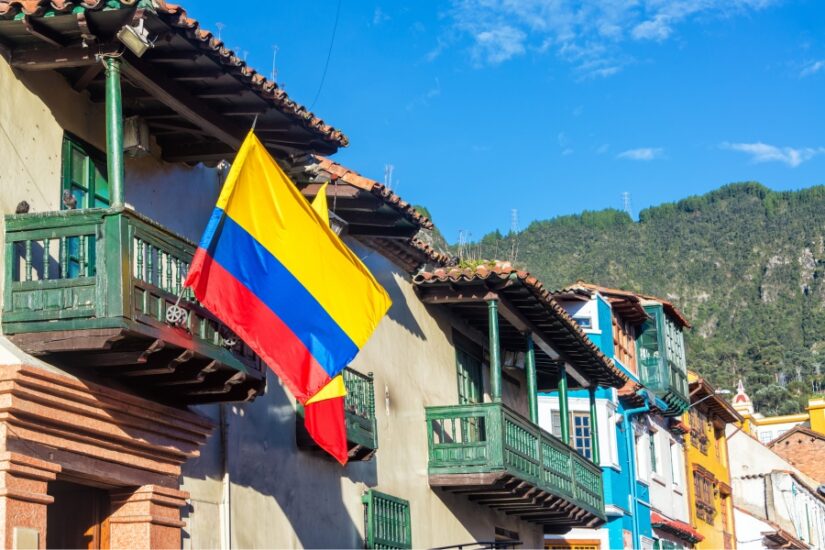
Bogotá sits at 2,600 metres above sea level in the heart of the Colombian Andes, ringed by green peaks that catch the clouds and give the city an atmosphere unlike any other capital in Latin America. It is a city of seven to eight million people – sprawling, complex, endlessly surprising, and buzzing with an energy that was recently recognised as the most genuinely local, authentic, and unfiltered of any city on earth.
The historic heart of Bogotá is La Candelaria. A neighbourhood of colonial churches, cobblestone streets, and university cafés, where street artists have turned entire building facades into extraordinary murals, and where some of the finest museums in all of Latin America sit within walking distance of each other.
The Museo del Oro is unmissable. Named by National Geographic as one of the most important museums in the world, it houses over 34,000 gold pieces and artefacts from Colombia’s pre-Hispanic indigenous cultures – a collection so extraordinary that the famous “Golden Raft” alone, a tiny masterpiece depicting a Muisca chief surrounded by his nobles on a ceremonial lake offering, is worth the entire journey. The Botero Museum, free to enter, contains not only the exuberant, oversized figures of Colombia’s most celebrated artist Fernando Botero, considered the most recognised and widely quoted living Latin American artist, but also a remarkable collection of international works including Picasso and Renoir.
But Bogotá’s culture extends far beyond its museums. The city hosts more than 18,000 public and private cultural events every year – from the world’s largest free music festival, Rock al Parque, to intimate jazz concerts, food festivals, and a dining scene that has quietly become one of the most exciting in the Americas. Chef Leonor Espinosa’s restaurant Leo, recently ranked among the World’s 50 Best Restaurants, serves a tasting menu that journeys through Colombia’s extraordinary biodiversity, using ingredients from indigenous and Afro-Colombian communities across the country. It is as close as you can get to eating the whole of Colombia in a single sitting.
Beyond the city itself, the extraordinary Salt Cathedral of Zipaquirá, an underground cathedral built inside the tunnels of a working salt mine, 200 metres below ground, sits less than an hour from the capital. And the Paloquemao market, where Bogotá feeds itself from long before dawn, is one of those experiences that recalibrates your entire sense of what abundance looks like.
Bogotá is the Colombia that most travellers skip too quickly. It rewards those who slow down.
The Amazon: Into the Lungs of the Earth
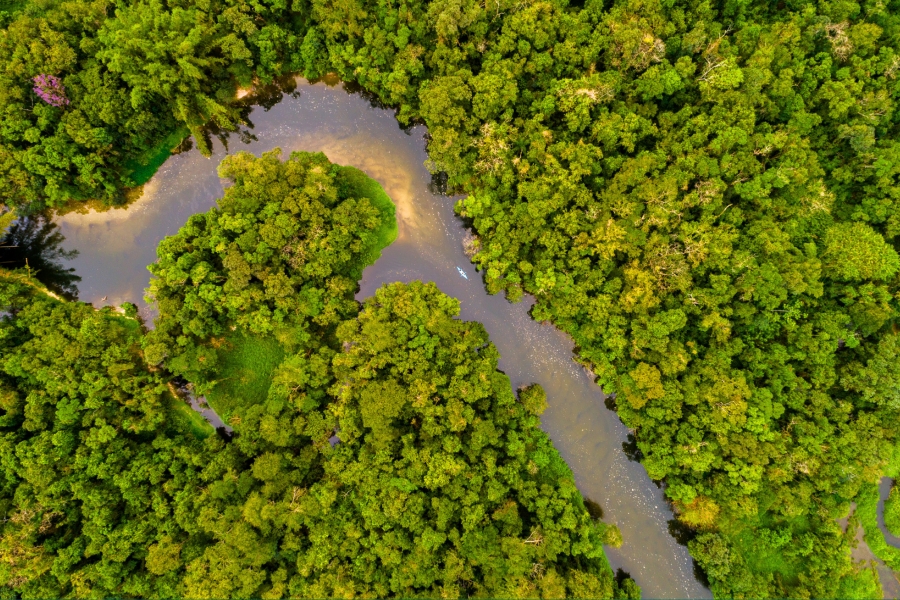
From Bogotá, a two-hour flight south takes you to Leticia – a small, friendly frontier town on the banks of the Amazon River at the southernmost tip of Colombia, where three countries converge: Colombia, Peru, and Brazil. You can walk across the border for ceviche in Peru and a caipirinha in Brazil, and return to Colombia before sunset. Nowhere else on earth is quite like it.
But Leticia is really a gateway, not a destination. The destination is the rainforest.
From the town, you travel by boat, the only way in, through channels of the Amazon River into the Amacayacú National Natural Park and the indigenous communities of Mocagua and San Martín de Amacayacú, where the jungle closes in on both sides of the water and the sounds of the forest take over. Howler monkeys announce themselves from the canopy. Macaws and toucans move between the trees. The air is thick, warm, alive with the weight of biodiversity. Colombia’s Amazon region alone is home to over 3,000 distinct species of fish, 195 species of mammals, and more plant species than most continents.
The days in the Amazon are extraordinary in their variety. You wake to dawn chorus, a symphony of birds and insects so layered and complex it takes several mornings to begin to distinguish individual voices. Guided canoe tours take you through narrow channels draped in green, past trees whose roots rise from the water in elaborate buttresses. Anacondas rest on banks. Poison dart frogs, vivid red and blue, impossibly small, sit on leaves at the water’s edge. Fishing for piranhas in the afternoon sun turns out to be surprisingly companionable, the small, fierce fish snapping at the bait with startling efficiency.
And then there are the pink river dolphins. The boto, or Amazon river dolphin, is one of those creatures that seems too extraordinary to be real – pink-skinned, long-beaked, deeply intelligent, surfacing beside the boat with a gentleness that belies its strength. Encountering them in the wild, in their river, on their terms, is one of those moments that stays with a traveller.
Night walks in the Amazon are extraordinary in their own right. The jungle transforming entirely after dark, torchlight finding tarantulas, caimans floating with red eyes at the waterline, and the extraordinary sounds of a forest that never truly sleeps.
The days here are unhurried and immersive in a way that no other experience on the trip quite matches. There is no WiFi. There is no phone signal. There is only the river, the jungle, and an astonishing quantity of life.
The Coffee Region: Colombia’s Most Beautiful Landscape
From the deep Amazon to the Andean highlands – the contrast could not be more dramatic, or more exhilarating.
The Eje Cafetero, or Coffee Region, is a UNESCO-recognised cultural landscape stretching across the departments of Caldas, Risaralda, and Quindío in the heart of Colombia. It is, quite simply, one of the most beautiful places we have ever visited anywhere in the world: a landscape of steep green hillsides draped in coffee plants, misty cloud forests, rushing rivers, and brilliantly coloured colonial towns whose churches and plazas and painted timber facades seem almost too photogenic to be real.
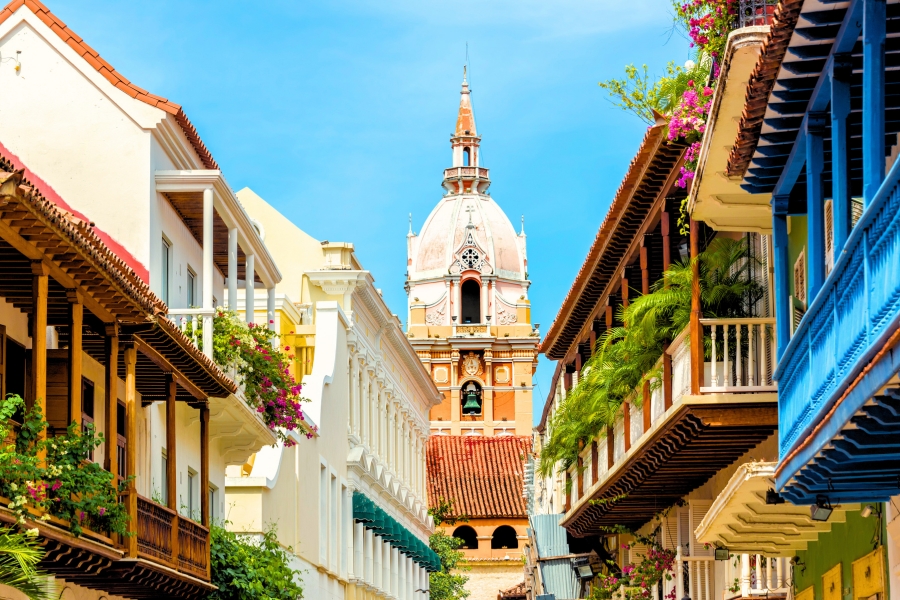
The gateway to all of it is Salento, a small, spectacularly charming town of around 7,000 people, its streets lined with balconied colonial buildings painted in every shade of ochre, terracotta, sky blue, and emerald green. The central plaza, framed by wax-palm-lined hills and surrounded by cafés serving the finest coffee you have ever tasted in your life, is one of those places where you sit down for fifteen minutes and realise two hours have passed.
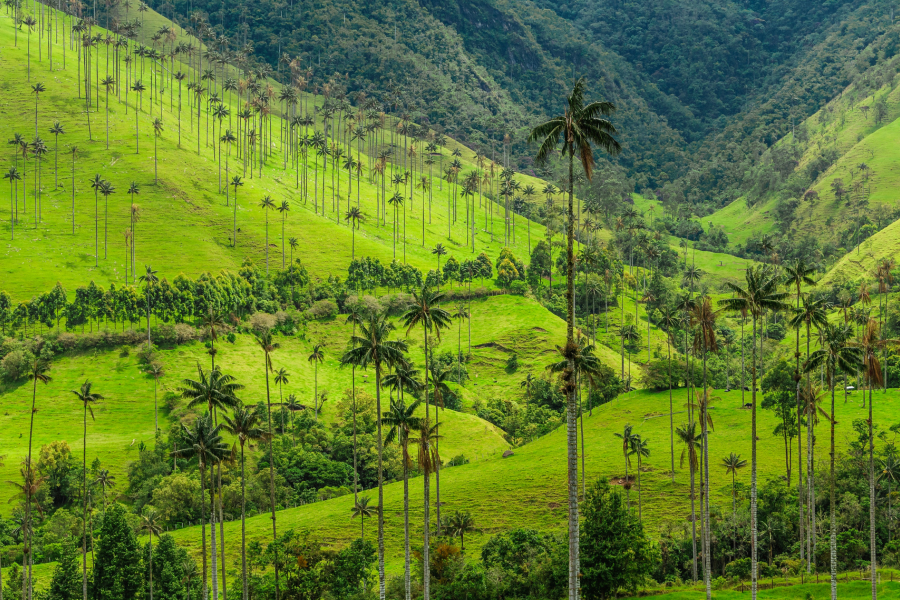
From Salento, vintage Willys jeeps, the iconic Colombian farm vehicles that have been rattling these mountain roads since the 1940s, take you into the Cocora Valley, and what you find there is one of the great natural spectacles of the Americas.
The Quindío wax palm is the national tree of Colombia. It grows nowhere else on earth in these concentrations. And it is enormous – the tallest palm species in the world, reaching heights of up to 60 metres, with a slender, solitary trunk that seems to go on forever before exploding into a feathery crown so high above your head that you have to tilt back to see it. To walk through the Cocora Valley at dawn, the valley floor still wrapped in mist, the palms rising from the cloud like something from a fairy tale. This is an experience that even the most well-travelled guests consistently describe as one of the most beautiful things they have ever seen.
The hike through the valley takes five to six hours at a gentle pace, moving through cloud forest, crossing streams on rope bridges, climbing to viewpoints that open out across the valley, and eventually descending back through the palms as the mist burns off in the morning sun. It is magnificent.
But the Coffee Region is more than scenery. The coffee itself, grown on family-owned fincas whose owners have been tending these slopes for generations, is among the finest in the world. A farm tour here is not a tourist experience tacked onto a commercial operation. It is a conversation with a family who has spent their lives understanding the relationship between altitude, rainfall, volcanic soil, and bean. You pick, you process, you roast, and then you drink – fresh, medium-roasted Colombian coffee in the place it was grown and you understand, perhaps for the first time, what “coffee” is actually supposed to taste like.
The Eje Cafetero is also home to extraordinary bird life, thermal springs, and the snow-capped peaks of Los Nevados National Park – whose glaciers and high-altitude páramos offer hiking for the more adventurous. The region manages to be simultaneously deeply relaxing and endlessly stimulating. We could stay for a month.
Caribbean: Cartagena and the Coast
The final chapter of the Colombia journey is the most theatrical.
Cartagena de Indias, founded in 1533 by Spanish conquistadors who used it as the primary port for shipping gold and silver from the New World back to Europe, is one of the great colonial cities of the Americas. Simón Bolívar, during the Wars of Independence, awarded it the title it bears to this day: La Heroica. The Heroic City. Walk its streets and you understand exactly why.
The Walled City is a UNESCO World Heritage Site. A labyrinth of cobblestone streets, 400-year-old churches, flower-draped balconies, hidden courtyards, and pastel-painted mansions that glow in the Caribbean sun with a golden, almost theatrical perfection. The imposing walls themselves, built over two centuries to protect the city from pirates including Sir Francis Drake and the British Admiral Vernon, stretch for 11 kilometres around the old city, and walking them at sunset, with the Caribbean Sea turning pink on one side and the terracotta rooftops of the old town glowing on the other, is one of those moments that feels almost scripted in its beauty.
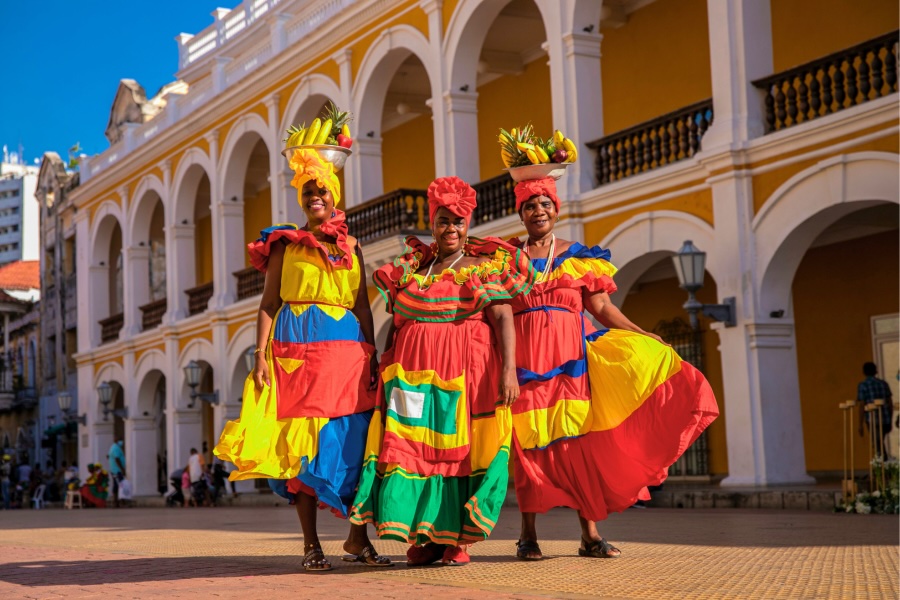
But Cartagena is much more than its colonial architecture. It is a city of Afro-Colombian culture in its fullest, most vibrant expression – a place shaped by five centuries of African, Indigenous, and Spanish influences weaving together into something entirely its own. The palenqueras, women from the nearby community of San Basilio de Palenque, Colombia’s first free African town founded by escaped enslaved people in 1603 — move through the streets in brilliant skirts and headscarves, balancing bowls of tropical fruit on their heads, their presence a living reminder of the history that built this city and the resilience of the people who survived it.
Getsemaní, the neighbourhood just outside the walls, is Cartagena’s creative soul. Its streets covered in vivid murals, its plazas filled with music and dancing until late, its cafés and bars giving the city its Afro-Caribbean heartbeat. This is the neighbourhood that Gabriel García Márquez, Cartagena’s most famous literary son, might have imagined in Love in the Time of Cholera – magical, sensory, alive.
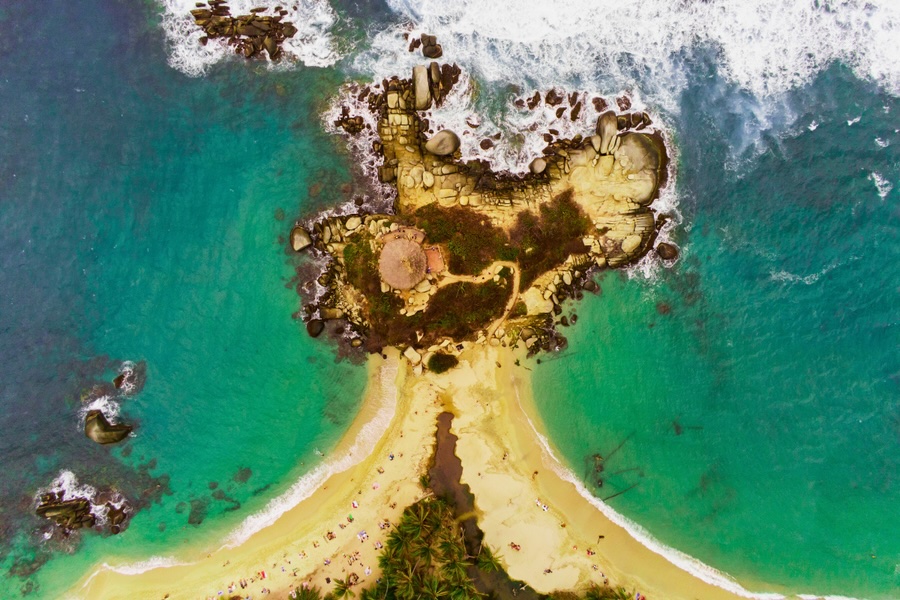
A day trip to the Rosario Islands, a chain of coral islands in the Caribbean, an hour by boat from Cartagena, offers turquoise water and white sand so fine it squeaks. Snorkelling through the coral reveals fish of extraordinary colour. And a boat excursion to El Totumo, a small mud volcano an hour north of the city where you float effortlessly in warm, mineral-rich grey mud while farmers from surrounding villages rub your shoulders with great enthusiasm, is one of those experiences that is so strange, and so Colombian, and so entirely delightful that you find yourself grinning about it for the rest of the trip.
The Caribbean food of Cartagena is a discovery entirely of its own: cazuela de mariscos (a creamy seafood stew with coconut milk, shrimp, mussels, and fish), arroz con coco (rice cooked in coconut milk), fresh ceviche, and the extraordinary abundance of tropical fruits from maracuyá, guanábana, lulo to corozo, that appear in juices and desserts and cocktails throughout the city. It is richer, spicier, and more deeply Caribbean than the food of the Colombian interior, and it is wonderful.
Cartagena is the perfect ending to a journey through Colombia. You have seen the country’s intellectual heart, its ancient wilderness, its coffee-growing soul, and now its sun-drenched, music-filled, historically resonant Caribbean face. You leave feeling that you have genuinely, thoroughly understood a place – which is the greatest thing travel can offer.
Ready to Experience Colombia for Yourself?
This journey is one of the most ambitious and rewarding itineraries we offer anywhere in the Americas. The combination of Bogotá’s authenticity and cultural depth, the raw wildness of the Amazon, the otherworldly beauty of the Coffee Region, and the Caribbean warmth of Cartagena creates a trip that genuinely feels like four holidays – each one extraordinary in its own right, and together forming one of the finest South American adventures available.
Colombia is a country that has worked hard to welcome the world. And the world is beginning to notice.
Get in touch with the Untravelled Paths team today to find out more, request a detailed itinerary, or simply ask us anything about what to expect. And if you’d like a proper conversation about the trip, we’d be delighted to schedule a call with one of our team – just say the word and we’ll find a time that works for you.
Colombia is waiting. It is magnificent. And it is time to go.
Written by James Chisnall